
 Trade
Trade
 Menu
Menu






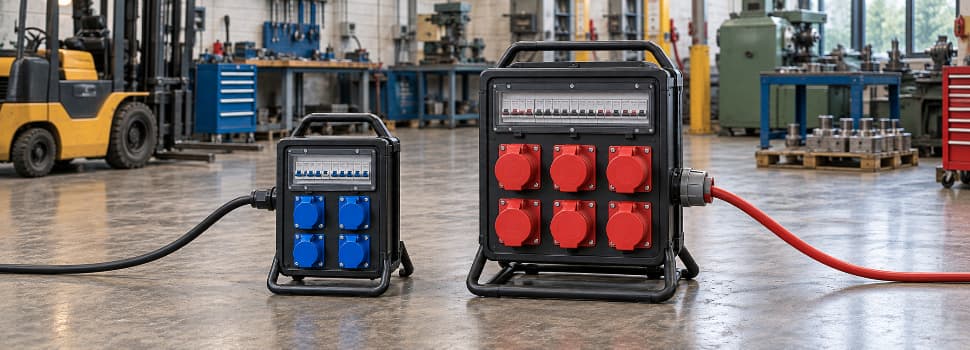
Do you need a single-phase or three-phase power distribution unit?
If you’re setting up temporary power for an event, construction site, workshop or industrial project, you’ll need to decide whether single-phase or three-phase distribution is right for the job.
Sometimes the answer is obvious. You know what supply is available, you know what equipment you’re running, and you just need the right power distribution box to bring it all together safely.
But it isn’t always that straightforward.
You could have dozens of lights, tools, laptops or pieces of sound equipment running at 230V and still be better off with a three-phase distribution box. It depends on the total load and how you need to split the power across your equipment.
Ultimately, it comes down to what supply you have available, how much power you need and where that power needs to go.
So, what’s the difference between single-phase and three-phase distribution? Here’s what you need to know.
What’s the difference between single-phase and three-phase power?
Single-phase is the 230V supply most people are familiar with, although you may also see it referred to as 240V on electrical equipment and product specifications. In industrial power distribution, you’ll usually recognise single-phase connections by their blue plugs and sockets.
It’s used for all sorts of equipment, including lighting, power tools, laptops and other smaller electrical equipment. If the total power requirement is relatively low, a single-phase distribution box may be all you need.
Three-phase is designed to handle much larger loads. Instead of using a single phase, it uses three alternating phases to supply power more evenly and provide greater capacity.
In the UK, three-phase supplies are generally 400V, although 415V is still a term you’ll hear regularly. Industrial three-phase plugs and sockets are typically red, making them easy to distinguish from blue 230V single-phase connections.
Three-phase power is commonly used for machinery and industrial equipment, but it’s also widely used for events, construction sites and temporary installations where a lot of power needs to be distributed.
And importantly, having a three-phase supply doesn’t mean all of your equipment needs to be three-phase.
Three-phase doesn’t mean everything you connect needs to be three-phase
A three-phase distribution box can take a larger three-phase incoming supply and split it into multiple 230V single-phase outputs. So, you don’t need to be running large three-phase machinery to have a reason to use one.
A festival is a good example. There might be lighting, sound systems, screens, laptops, catering equipment and other kit all running at the same time. Most of it could be standard 230V equipment, but together it can add up to a significant electrical load.
Instead of trying to run everything from a single-phase supply, a three-phase Rubber Box can distribute that load across the available phases while providing the 230V outputs needed around the site.
This is known as phase splitting, and it’s one of the main reasons three-phase distribution is so useful for larger temporary power setups.
The same applies on construction sites, in workshops and in industrial environments. You might have three-phase power available at the source, but much of the equipment you need to connect could still be standard 230V.
With the right distribution box, you can make use of the capacity of a three-phase supply while still providing the familiar blue 230V connections needed for everyday equipment.
Why the load still matters
Having enough sockets doesn’t always mean you have enough power. A distribution box might have ten outlets, but whether you can use them all at once depends on what you’re plugging in and the supply feeding the box.
Ten laptops, for example, will place a very different demand on the supply than ten pieces of high-powered equipment. That’s why the total load is just as important as the number of outlets when specifying a distribution box.
With three-phase distribution, you also need to consider how that load is spread across the three phases. Putting too much demand on one phase can cause problems, even if there’s enough capacity across the supply as a whole.
So, choosing the right distribution box isn’t just about counting how many sockets you need. You also need to know what you’ll be running from them and what supply you have available.
What should you check before choosing a distribution box?
Once you know whether single-phase or three-phase distribution is likely to suit the job, there are a few more details to consider before choosing a box.
You want to match the distribution box to both the supply available and the equipment you need to run. To do that, there are three main things to check.
1. What power does your venue, generator or site actually provide?
Start by checking the power supply you have available. Is it single-phase or three-phase? And what size is the supply – 16A, 32A, 63A, 125A or something larger?
This matters because the incoming supply determines how much power is available for the distribution box to work with. The box can split that power between different sockets and pieces of equipment, but it can’t provide more power than the supply feeding it.
Once you know the type and size of supply available, you can start narrowing down which distribution boxes are suitable for the job.
2. How much power does your equipment need in total?
Next, look at everything you plan to connect to the distribution box and, importantly, what is likely to be running at the same time.
Different equipment can place very different demands on the supply. A laptop or a light, for example, will generally require much less power than a heater or a large piece of machinery. Checking the power requirements of each item and considering their combined load will give you a better idea of how much capacity you actually need.
This helps you choose a power distro box that can comfortably handle the equipment you intend to run, rather than simply choosing one based on the number of sockets it has.
3. Does anything require a direct three-phase connection?
Finally, check whether any of your machinery or equipment needs a direct three-phase connection. These are typically the red plugs and sockets we mentioned earlier and are commonly used for equipment with higher power requirements.
If you do have equipment that needs a three-phase connection, make sure the distribution box has the correct outlet for it, as well as any blue 230V single-phase sockets you need for other equipment.
If everything you’re running uses standard 230V connections, you may still benefit from three-phase distribution where the overall load is high. As we covered earlier, a three-phase box can split the incoming supply across multiple 230V outlets.
Once you know what supply is available, how much power your equipment needs and whether anything requires a direct three-phase connection, you’ll have a much clearer idea of the distribution box you need.
Getting the right distribution for the job
It isn’t a case of single-phase being better than three-phase, or vice versa. It comes down to what you need to power and the supply you have available.
For a smaller setup with a relatively modest load, single-phase distribution may be all you need. If you’re dealing with a much larger load, have three-phase equipment to supply or need to split a larger incoming supply across a number of 230V outlets, three-phase distribution may be the better option.
Choosing between the two is only part of the specification. You’ll also need to consider the number and type of outlets, the protection required and the environment the distribution box will be used in.
If you’re ever unsure about what you need, or you’d simply like a bit of guidance before making a decision, our friendly team is always happy to help. Just get in touch and we can talk through your requirements and help you find the right distribution setup for the job.
At Rubber Box, we’ve been designing and manufacturing power distribution equipment in the UK for more than 30 years, so these are questions we deal with every day. We manufacture standard single-phase and three-phase distribution boxes for a huge range of applications, alongside more bespoke units for requirements that don’t fit an off-the-shelf product.
If you have any questions about our products, just our team a call on +44 (0)1282 677 910 or email info@rubberbox.co.uk, for more information.